



If you’re new to proxies, the term residential proxy might sound technical or confusing. Actually, the concept is super simple and by understanding it you can browse much safer, you can easily manage accounts without blocks, and collect data without running into usual restrictions.
In this guide, we’ll explain residential proxies in a clear, practical way. No fancy words, no technical complexity, just the essentials you need to start using proxy servers.
So what is a residential proxy?
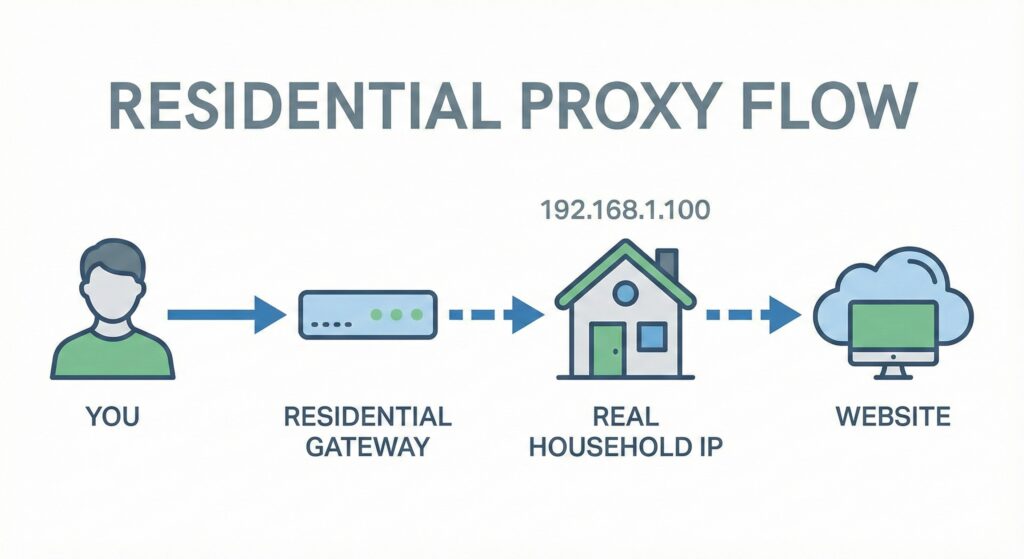
Residential proxy is an internet connection that uses a real IP address from someone’s home. That means when you browse or connect through a residential proxy, websites see you as a general user, not a bot, not a server, and not a suspicious IP.
Here is a simple illustration:
This makes your traffic look natural, which helps to reduce blocks, captchas, and verification prompts.
How are residential proxies different from datacenter proxies?
Datacenter proxies are hosted in cloud infrastructures like AWS or DigitalOcean. They’re fast, but easily detected and often blocked.
As I mentioned before, residential proxies use real IPs from real users which making them:
- harder to catch
- safer for account management
- better for location-specific tasks more trusted by websites
Let’s make it even more simple: “Residential proxies look real, because they are real.”
Like our content? Subscribe and get the best proxy deals every month.
Why do people use residential proxies?
Here are the most common practical reasons people choose residential proxies:
Managing multiple accounts safely
Platforms like Facebook, Instagram, TikTok, and Amazon react aggressively to multiple accounts from a single IP. So using residential proxies isolates identities and reduces checkpoint risks.
Avoiding IP blocks and CAPTCHAs
Residential IPs have higher trust because they come from real ISPs, so anti-bot systems treat them more easily.
Geo-targeting content
Residential proxies make it possible to view content exactly as real users in a specific region see it. Perfect for SEO research, ads verification, or price comparison.
Scraping without getting blocked
Web scraping tools perform far better when requests come from real household IPs instead of cloud servers.
Accessing Blocked Websites
If a website is restricted by your office, school, or region, residential proxies help you bypass these limitations safely.
Why do people use residential proxies?
At a high level, the process looks like this:
- You connect to a gateway endpoint;
- The gateway assigns you a residential IP;
- Your request reaches the target website;
- The website sees a normal household IP and allows access;
- Depending on your settings, the IP can remain the same (static) or rotate.
This single endpoint gives you access to 20+ million residential IPs across 195+ countries.
Rotation vs static sessions - what’s the difference?
Residential proxies usually offer two ways of handling IPs: rotating sessions and static sessions. Both serve different purposes, and understanding the difference helps you choose the right mode for your task.
Rotating sessions (new IP every request or based on rules)
Static sessions – sometimes called sticky sessions, allow you to keep the same residential IP for a defined period. At WeProxies, a static session can last up to 10 minutes, giving you enough stability to log in, warm up an account, or perform sensitive actions without constant IP changes.
This method is especially useful in the case of social media accounts, ecommerce dashboards, or any service that keeps track of your IP for security reasons. Trust is usually associated with consistency: if an account detects you switching IPs every few seconds, it might ask for verification or categorize your activity as strange. A stable IP escapes this trap and simulates the behavior of a normal user who is being connected from the same household for the whole period of their session.
Static sessions (Same IP for up to 10 minutes)
The rotating session will periodically give you a new residential IP address. Rather than routing all your traffic through one IP, your connection continuously hops around the proxy pool.
This approach is particularly better for operations that require a large number of requests. When scraping, checking search results, or acquiring large datasets, sites usually limit the number of requests that can come from a single IP in a short period. Rotation distributes your traffic over numerous different residential IPs, making it much more difficult for websites to notice patterns. Therefore, rotating sessions are considered a safe choice for large-scale automation, SEO monitoring, and any workflow where you want to avoid repetitive actions from the same IP.
Why location targeting matters?
Residential proxies give you control over where your traffic appears to come from. With WeProxies, you can choose IPs from more than 195 countries, and even narrow down to city-level targeting where available.
Accurate location targeting allows you to view genuine search results from different countries, verify how ads appear to local audiences, and avoid the “geo-mismatch” issues that often trigger security checks on social media and ecommerce accounts. It also makes tasks like price comparison, market research, and testing region-specific features far more reliable.
In short, correct location targeting increases both trust and relevance, whether you’re scraping data, managing accounts, or analyzing how a website behaves across different markets.
Residential proxy accuracy depends on the provider
Not all proxy networks are equal. Many providers recycle IPs, reuse abused subnets, or fail to filter broken connections.
A professional residential proxy network needs to:
✅ Filter bad IPs
✅ Monitor pool health
✅ Remove abused ranges
✅ Maintain uptime
✅ Offer stable sessions
✅ Support global coverage
At WeProxies, we maintain:
- 20,000,000+ real residential IPs
- 99% uptime, monitored continuously
- Global coverage in 195+ countries
- Load-balanced infrastructure
- Fast failover
- One gateway endpoint (no proxy lists needed)
This ensures clean, trustworthy traffic.
Pricing models: understanding residential proxy costs
Residential proxies are known for being more expensive than datacenter proxies, but that price reflects the higher trust, better quality, and far lower block rates that only real household IPs can provide. When you’re managing accounts, collecting data at scale, or working with platforms that aggressively filter automated traffic, paying for residential IP quality is almost always worth it.
At WeProxies, our residential proxies start at just $1.37, and the final price depends on how much traffic you need. Smaller users can begin with a few dollars, while larger customers benefit from volume discounts as their usage grows. This flexible model ensures you always get the best possible residential proxies price for your workload.
Final thoughts: why residential proxies matter in 2026
The digital marketers, developers, researchers, ecommerce teams, and all the other people who want to have a reliable access to multiple platforms and that too without triggering blocks consider residential proxies as must-have tools.
WeProxies allows you to connect with a worldwide network of more than 20 million residential IPs located in 195 countries, equipped with city-level targeting, 10-minute static sessions, rotating IPs, and 99% uptime. Everything from the same simple gateway endpoint. We give you the option of choosing a flexible pay-as-you-go or monthly plan, and our small tech team is quick to respond, enabling you to start with a small amount, test different locations freely, and grow confidently with the support you require.